


An Assault Arrest Does Not Rule Out Self-Defense
“But I was defending myself.”
We hear it in the first phone call, and it’s usually true. It also didn’t stop the arrest. Police arriving at a chaotic scene don’t adjudicate self-defense at the curb — they pick the person they believe was the aggressor, based on who’s bigger, who’s calmer, who’s bleeding, and who talked the most, and they make an arrest. Whether the force you used was lawful gets sorted out later, in a courtroom, by lawyers. Sometimes, it’s easier to arrest both parties.
The first thing to understand about self-defense in Washington: it is a genuine, complete defense to an assault charge, and it is also something that has to be raised, supported, and proven up the right way. It is never obvious, no matter how obvious it felt in the moment and still feels to you. This page covers what the law actually requires — and what quietly defeats the claim before it ever reaches a jury.


What Washington Law Actually Says
Washington law makes the use of force lawful when you reasonably believe you are about to be injured — or when you’re aiding someone else you reasonably believe is about to be injured — and the force you use is no more than necessary to prevent the harm.
Strip away the legal phrasing and there are three working parts:
You believed harm was imminent — about to happen, not threatened for later, not payback for earlier.
That belief was reasonable under the circumstances as they appeared to you at the time.
The force you used was proportional — enough to stop the threat, not more.
Each of those words — imminent, reasonable, proportional — will be picked apart by the prosecutor. Building the claim means being ready for all three.
The Burden of Proof in a Washington Self-Defense Case
The Burden Belongs to the State
Here is the part of Washington self-defense law that surprises nearly everyone, including people who think they know how it works. Once self-defense is properly raised — with some evidence to support it — the burden shifts to the prosecution. The state must prove, beyond a reasonable doubt, that the force you used was not lawful. If the jury isn’t convinced beyond a reasonable doubt that your force was unlawful, they are instructed to acquit.
That is an enormous structural advantage, and it’s the reason a properly built self-defense case changes the entire posture of a prosecution. But note the qualifier in that paragraph: properly raised. The burden doesn’t shift because you say the words “self-defense.” It shifts when the defense is supported with evidence — witness accounts, injuries, video, the physical scene, the sequence of events. That evidence has to be found, preserved, and presented. That’s the job.

The Role of Reasonable Belief in a Self-Defense Case
You Are Judged in the Moment — Not in Hindsight
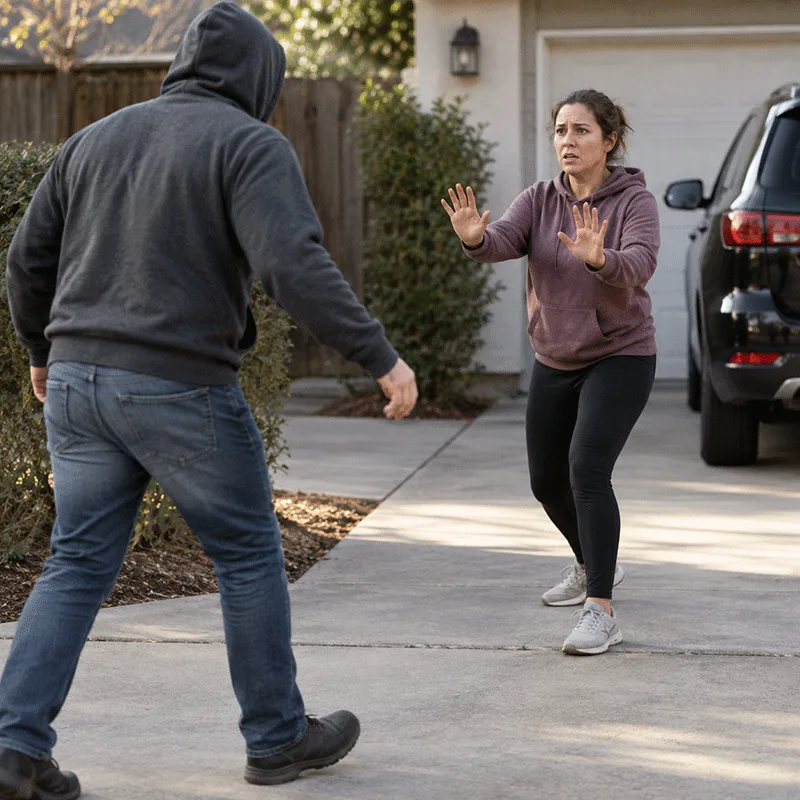
Washington law evaluates self-defense from your perspective at the time, taking into account all the facts and circumstances known to you — including things that happened before the incident. The question is what a reasonably prudent person would have done standing where you stood, seeing what you saw, knowing what you knew.
This matters because every self-defense case gets replayed in slow motion by people who weren’t there. The prosecutor has weeks to study a decision you made in two seconds. The law’s answer to that unfairness is the reasonable-appearances standard: you didn’t have to be right about the threat. You had to be reasonable about it. A raised fist that turns out to have been theatrics can still justify a defensive response, if a reasonable person in your position would have read it the same way.
The Right to Stand Ground in Self-Defense Cases
There Is No Duty to Retreat
Washington does not require you to run. If you are somewhere you have a lawful right to be, you may stand your ground and defend yourself against an attack. You are not required to retreat, and a prosecutor cannot argue that your failure to flee makes your force unlawful.
That said, there’s a difference between what the law requires and what a jury notices. Whether you could have simply walked away is something jurors think about whether they’re supposed to or not — and it feeds into whether your force looks necessary. Standing your ground is your right. How that choice is presented to a jury is strategy.
Proportional Force — and the Stricter Rules for Deadly Force
The law authorizes the force necessary to stop the threat. Not the force that felt deserved, not the force that made sure it never happened again. A shove answered with a shove is one case. A shove answered with a beating that continued after the other person was down is a different case, and the second half of it is where self-defense claims die. When the threat ends, the lawful force ends with it.
Deadly force is held to a much stricter standard. It is justified only when you reasonably believe you or another person are in imminent danger of death or great personal injury. The gap between “about to be injured” and “about to be killed or gravely injured” is the gap between an ordinary self-defense case and a fight for your life in court. Anyone who used a weapon — or anything a prosecutor can call a weapon — should assume the state will build its whole case in that gap.


What Defeats a Self-Defense Claim
Prosecutors don’t usually attack self-defense head-on. They look for one of a handful of openings.
You started it. A person who provokes the confrontation generally can’t claim self-defense for what follows. Expect the state to comb through the lead-up — words, gestures, who approached whom — looking for a way to cast you as the first aggressor.
You went too far. The threat was over and you kept going. Or the response was wildly out of scale with the threat.
Your own statement. “I hit him first, but he was coming at me” feels like an explanation when you say it to an officer. In the report, the first four words survive and the rest becomes noise. More self-defense claims are damaged at the scene, by the person who ends up charged, than by any witness.
The missing evidence. The bruise nobody photographed. The witness nobody found. The video that got overwritten. A claim the law supports can still fail for lack of proof — and the proof starts disappearing immediately.
Legal Cost Reimbursement After an Acquittal
If Your Force Was Lawful, the State May Owe You
Washington has a provision most states don’t: when a person charged by the state is found not guilty because their use of force was lawful, they may be entitled to reimbursement of their reasonable attorney fees and costs. The legislature’s message is hard to miss — people shouldn’t be bankrupted for lawfully defending themselves.
Note: this exists, it is widely commented on all over the Internet . . . and it comes with tons of ‘maybes’ and contingencies. It doesn’t apply in every case or every court, and it doesn’t undo the months of stress.

How We Build a Self-Defense Case
Simply: we tell your story and we tell it right.
Get Legal Help with an Assault Charge in Washington
The Arrest Was Not the Verdict
Getting arrested after defending yourself feels like the system has already decided. It didn’t. The officer made a snap judgment at a chaotic scene; the law gives you a real path to being cleared — but that path has to be built while the evidence still exists.
Call Knauss Law today. The record that clears you starts now.
Knauss Law is a criminal defense firm in Washington State. We represent clients throughout the Greater Seattle Area.