


The Speedy Trial Rule Is Treated More as a Suggestion Than an Actual Rule
On paper, the concept sounds both reassuring and principled: the government cannot drag its feet indefinitely, and you have the right to be brought to trial within a defined time frame. The idea is that justice delayed is justice denied, and that the system is obligated to move with urgency when a person’s freedom, reputation, and future are on the line.
In Washington, the rule even comes with specific timelines attached to it. Deadlines exist. Calendars are marked. Language appears precise. But the lived reality of criminal defense in this state tells a very different story.
Because what looks like a firm rule from the outside operates far more like a flexible guideline once you are inside the system.
The moment a case begins to stretch, the exceptions start multiplying. Continuances become routine. Scheduling conflicts become persistent. Delays for “Good cause” turns into a catch-all justification. Delays are framed as unavoidable, reasonable, or procedural necessities, even when those delays steadily erode the position of the person who is actually waiting under the weight of the accusation.
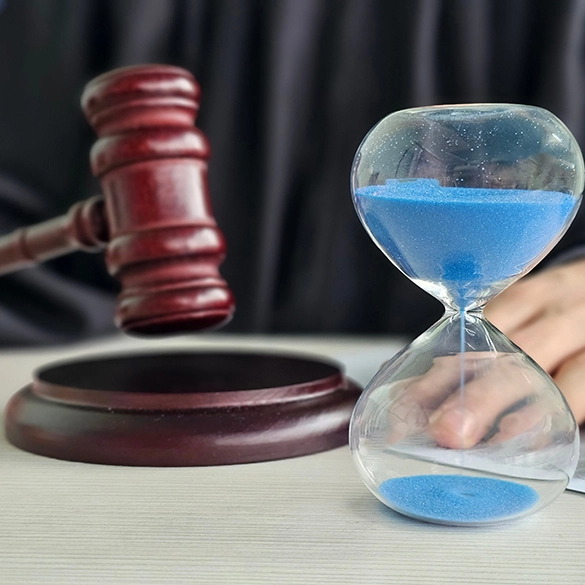

Delays Almost Always Favors the Prosecution
What is rarely acknowledged is that in Washington, time almost always favors the prosecution.
The longer a case drags on, the more the state benefits from the delay. Witnesses align more comfortably with the narrative. Investigations subtly evolve to patch early weaknesses. Strategy becomes more refined. Meanwhile, the person accused absorbs the pressure of pending charges while being forced to live under pre-trial conditions that resemble punishment long before any verdict is entered.
This is not a neutral passage of time. It is a slow tightening of the screws – on you if you don’t have help.
Delay as Quiet Leverage
Every additional week a case remains unresolved imposes a cost that does not appear on a docket. Financial strain deepens. Employment becomes fragile. Relationships strain under prolonged uncertainty. Stress compounds. Anxiety builds. The psychological toll of existing in legal limbo settles into everyday life.
If you are also subjected to pre-trial conditions — no-contact orders, travel restrictions, curfews, monitoring devices, drug or alcohol testing, mandatory treatment, ignition interlock requirements, reporting obligations — you are essentially living under a regime of control that looks and feels like a verdict that hasn’t happened yet. The system assures you that these are temporary measures, but as the months stack up, “temporary” starts to resemble a way of life.
And when fatigue sets in, when the effort of continuing to fight becomes emotionally and financially exhausting, the pressure to resolve the case — by whatever means necessary — becomes more intense. This dynamic overwhelmingly serves the prosecution.
The Fiction of Procedural Protection
Speedy trial rules were designed as a shield. In practice, they are often used as a framework the system learns how to maneuver within. Deadlines are adjusted, recalculated, or effectively reset through technicalities, consent-by-silence, or procedural nuance that the average person cannot realistically track or comprehend without active, informed legal guidance.
Most people do not realize that objecting at the wrong moment, failing to object at the precise moment, or relying on the court to manage its own timeline can quietly erase protections they assumed were automatic. And while that technical reality unfolds, the conditions imposed on their daily life remain very real, very restrictive, and very draining.
The supposed urgency behind a “speedy” process becomes more of an abstraction, something discussed in theory while the accused continues waiting, complying, adjusting, and carrying the burden of accusation with no finality in sight.

Why this matters
The romantic notion that delay simply allows for careful preparation ignores the power at play. The person accused does not experience delay as thoughtful caution. They experience it as prolonged uncertainty, mounting pressure, and steady erosion of both leverage and endurance.
The longer a case remains unresolved, the more likely it becomes that resolution happens not because the facts demanded it, but because exhaustion finally does.
And that exhaustion is not accidental. It is built into the very structure of delay.
Where Knauss Law Fits
Knauss Law does not treat time as harmless process noise or bureaucratic inconvenience. It understands that every unnecessary day a case remains unresolved strengthens the prosecution’s hand and weakens the client’s resolve. Delay is not tolerated passively. It is scrutinized, challenged, resisted, and strategically managed.
Because in Washington, the “speedy trial” rule rarely protects those who assume it will protect them automatically. It only has teeth when someone forces it to have teeth.
Without that push, what you are left with is a system that moves slowly, excuses its pace, and quietly benefits from every additional day you remain trapped inside it.
The rule may exist in language.
The reality unfolds in time.
And unless we actively intervene, time does exactly what the Washington criminal system has trained it to do:
It works against you.
 425-300-5566