


What Happens Once the System Decides
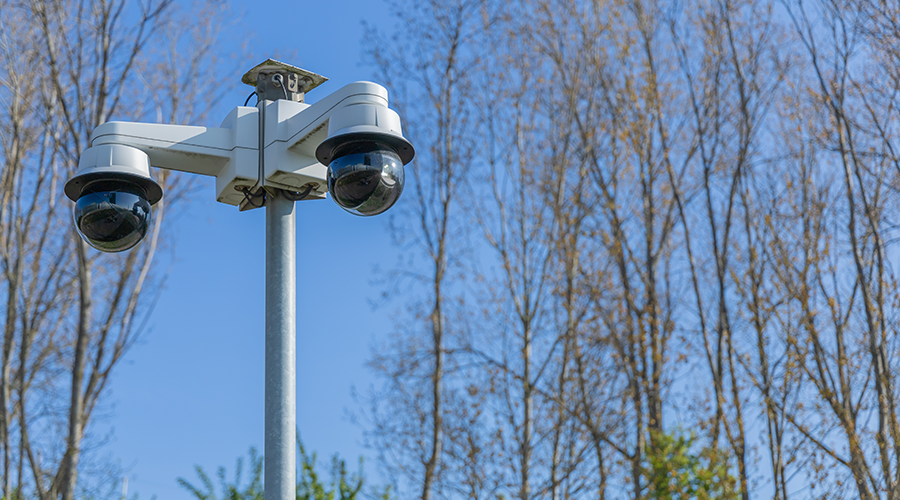
The image above is very real. It’s not a still from V for Vendetta or Children of Men or any other British dystopian film. It was taken recently in a suburb of London. In January, the Metropolitan Police announced that a four-month pilot program mounting live facial recognition cameras on lamp posts in the London borough of Croydon. In the last few weeks, that ‘experiment’ expanded to the Thames and a mobile, instant recognition, van that drives around scanning faces. So far, the Metropolitan Police are reporting over 110 arrests and counting.
The UK’s Equality and Human Rights Commission has already declared the policy unlawful to no effect.
The United Kingdom and the United States operate under different legal frameworks, and the Fourth Amendment is not nothing. But the London pilot is a preview of where law enforcement technology wants to go.
Meanwhile, here in the U.S., AI and facial recognition are in use while not advertised — sometimes even when it’s used as the basis for an arrest. Two recently ‘resolved’ cases from the last year may well be our preview.
Two Women. Two States They’d Never Visited.
Angela Lipps, a Tennessee grandmother, spent more than five months in jail on felony charges out of North Dakota — a state she’d never been to. Bank records placing her in Tennessee at the time of the crimes were available from day one. Nobody looked for them. The charges were dismissed on Christmas Eve.
Kimberlee Williams, an Oklahoma woman, spent six months in jail on charges from three Maryland counties — a state she’d also never visited. Three separate police departments had opened cases on her. None of them noted in their charging documents that the identification came from facial recognition. The charges were eventually dismissed, one county at a time, which stretched her time in custody well past when it should have ended.
In both cases, the exculpatory evidence wasn’t hidden. It was simply never sought. Once the system had a name, the investigation was over.
How a Suggestion Becomes an Arrest
Facial recognition AI does not identify people. It generates candidates — ranked matches from a database of prior arrest photos and scraped images. It is, by design, a place to start. In both of these cases, it became a place to stop.
This is confirmation bias in its most literal form. Once investigators had a name attached to a face, everything that followed was processed as confirmation. Williams had a prior check fraud history, which made her easier to believe guilty of check fraud somewhere else. That is not evidence. That is a story that fit, and fitting was enough. She told her interrogator directly that she had never been to Maryland. “You’re telling me, but you’re not telling me the truth,” the officer replied.
Graham Greene wrote about the impossibility of explaining anything to a man with power — before AI handed that man a printout to point at. Once the system has decided, explanation is not a viable strategy. Everything you say goes into the case being built against you, not the case being questioned. Every attempt to correct the narrative provides more raw material for the one already forming. This is confirmation bias weaponized by procedure, and it is not unique to facial recognition cases — it is how the system operates from first contact in virtually every criminal matter.
Nobody Along the Chain Is Incentivized to Stop
In the Fargo case, a neighboring agency’s AI system flagged Lipps as a potential suspect. That report was forwarded to Fargo detectives, who assumed — incorrectly — that surveillance photos had accompanied it. One assumption compounded another. Nobody stopped the chain because nobody in the chain is structurally incentivized to stop it. The officer reports to a supervisor. The supervisor defers to the detective. The detective submits to the prosecutor. The prosecutor advances the case. At each stage, the same posture: not my call, that’s for the next person up.
When something goes wrong early — a bad identification, a sloppy assumption, an unexamined tip — the incentive is not to correct it. The incentive is to move it forward. Once passed, the mistake gains institutional momentum. Not because anyone believes it is correct, but because no one wants to be the one who stops the machine and says: this should never have started.
The Fargo police chief acknowledged “a couple of errors” at a press conference — five months after Lipps was arrested. The Montgomery County detective who filed charges against Williams didn’t respond to press inquiries at all. Neither department has issued an apology. The system is far more comfortable creating an additional problem than admitting it made a mistake on the original one.
The Punishment That Doesn’t Wait for a Verdict
Most people assume the punishment, if there is one, comes at the end. After the trial. After the verdict. After the judge speaks. There is no clean line. Long before any finding of fact, the process itself begins extracting payment.
Lipps was extradited by plane, her first time flying — in handcuffs, on charges that should have been disproved before they were filed. Williams was separated from her family for six months, including an 11-year-old granddaughter who asked on the phone why grandma wasn’t coming home. Williams is now recovering in a Pennsylvania rehabilitation facility from an autoimmune disorder she believes may have been worsened by illnesses she contracted in jail.
The charges being dismissed is not justice. It is a late correction. The damage — the months, the fear, the health consequences, the reputational harm — is not returned when the case closes. The system took it and kept it. That is how the process works, and it works that way whether the underlying identification came from a witness, a police report, or an algorithm.
What Changes With a Lawyer in the Room Early On
Neither woman had an attorney in the room early enough to change what happened. An attorney doesn’t try to explain the situation to a detective who has already decided. Explaining doesn’t work. What works is demanding, in writing, the basis for the identification — and putting that question on the record before the machinery gets too far down the road to stop.
The evidence that ended both prosecutions was not sophisticated. Bank records. Social media posts. Signed declarations from family members who could account for where these women actually were. That is basic alibi investigation — the kind of work that takes days, not months. An experienced defense attorney gathers it immediately, before it scatters, and places it where the system cannot ignore it. Not in a letter to the detective. On the record, in front of a judge, as a challenge to probable cause.
Prosecutors are not, by nature, curious about what they’re missing. Once they accept the version of events provided by police, the system does not reward inquisitiveness — it rewards efficiency and forward motion. The defense attorney is the only person in that entire chain whose job is to create friction. To slow the machine. To force the question that nobody else is structurally required to ask: how, exactly, did you identify this person, and what did you do to verify it?
A Note on Washington State
Washington State law enforcement is adopting facial recognition technology at an accelerating pace. There is no statewide regulatory framework governing its use in criminal investigations. There is no requirement that defendants be told a facial recognition match was part of how they were identified. Maryland passed legislation in 2024 restricting these practices. Washington has not.
The cameras on the lamp posts in Croydon aren’t here yet. The technology that put these two women in jail is.
 425-300-5566